Blog
Progress and Prospects of 5G Messaging
I. Overview of 5G Messaging
China Telecom, China Mobile, and China Unicom jointly released the "5G Messaging White Paper" on April 8, 2020, for the first time proposing the concept of "5G Messaging." As an upgrade to traditional SMS services, 5G messaging has the following characteristics and advantages.
Rich business functions. 5G messaging reuses the short message and multimedia message service (SMS/MMS) gateway, while being compatible with SMS/MMS services. It breaks through the limitations of traditional SMS on message length and content format, supporting multiple media formats such as text, images, audio, video, location, contacts, and documents. Developers can develop lightweight applications based on these capabilities to provide users with a rich media communication experience.
Solid development foundation. Currently, China Telecom, China Mobile, and China Unicom have all begun large-scale deployment of 5G messaging. 5G messaging is expected to become one of the first 5G applications seen by individual users, providing telecom users with a direct service upgrade experience and representing a new development opportunity for 5G applications.
Broad market prospects. 5G messaging inherits many advantages of SMS services. Relying on the telecom number system and telecom-grade authentication technology, it naturally has advantages such as wide service coverage, high reach rate, and good credibility. In today's environment where operator messaging services are becoming saturated, the implementation of 5G messaging is a new driving force for the development of the telecommunications market.
Promoting the integration of the communications industry and vertical industries. 5G messaging includes personal messaging services, industry messaging services, and enhanced call-related messaging services. Both individual and industry users can obtain new messaging service experiences. In particular, the introduction of the MaaP concept can provide new space for the integration of the information and communications industry with other industries.
II. Technical Implementation of 5G Messaging
5G messaging is implemented based on GSMA RCS UP 2.4 and related standards, built on the IMS network, providing users with a collection of services such as voice, messaging, and status presentation. The 5G messaging system architecture is shown in the figure below, including terminals, 5G message centers, MaaP platforms, billing and settlement, message supervision, and interoperability, among which:
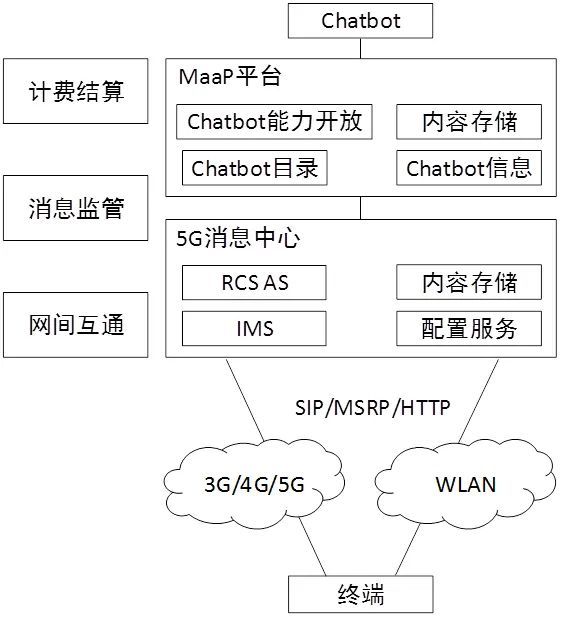
Terminal: The terminal accesses the 5G message center through the 3G/4G/5G network or WLAN, and the user uses the mobile phone number as the communication identifier;
5G Message Center: The 5G message center has functions such as 5G message management, distribution, and routing, providing a unified interface between terminals and networks. The 5G message center includes IMS access, RCS AS, content storage, and configuration management functions;
MaaP Platform: The MaaP platform is built on top of the 5G message center, providing a unified interface to Chatbot, responsible for the review and authentication of industry customer Chatbots, the upload and storage of multimedia content in industry messages, and supporting terminal queries of Chatbot directories and information;
Chatbot: Is a service provided by industry customers to end users in the form of a conversation. This service is usually based on artificial intelligence software, simulating human intelligent conversation to provide users with specific service functions;
Billing and Settlement: Used for billing and settlement of 5G messages. The billing points for 5G messages are in the 3G/4G/5G packet domain, 5G message center, MaaP platform, and interoperability gateway;
Message Supervision: Used to implement compliance review of message content and filtering and shielding strategies for inappropriate messages;
Interoperability: Used to achieve interoperability of 5G messaging services between different operators.
III. Current Status of 5G Messaging Standardization in China
Currently, domestic 5G messaging-related standard projects are being carried out simultaneously in multiple working groups of CCSA, led by the three major domestic basic telecommunications enterprises. The main content and directions include: general requirements, service requirements, terminal requirements, interoperability, support and guarantee, security, etc., as shown in the table below.
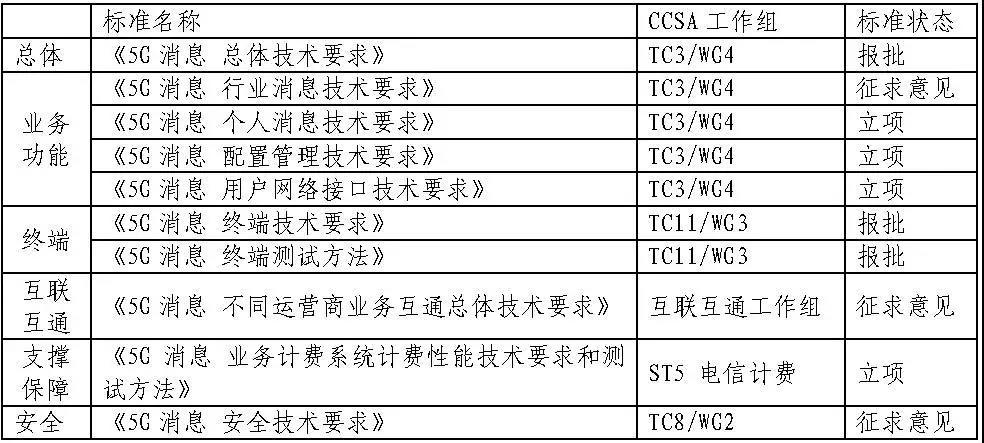
China's 5G messaging standardization work is steadily progressing. The approval of "5G Messaging General Technical Requirements," "5G Messaging Terminal Technical Requirements," and "5G Messaging Terminal Test Methods" indicates that the series of standards have the role of guiding enterprise 5G messaging practices.
IV. Promotion of 5G Messaging Industry in China
The participants in the 5G messaging industry chain mainly include terminal manufacturers, telecommunications operators, application developers, and industry customers. Among them, terminal manufacturers and application developers have not yet fully integrated into the industry chain.
Regarding terminal manufacturers, Since 5G messaging is a terminal-dependent service, it requires terminal upgrades and modifications to reuse the SMS/MMS gateway to support 5G messaging. Although some models of brands such as Huawei, ZTE, Xiaomi, Honor, OPPO, and vivo currently support it, the terminal coverage is still insufficient. As the 5G messaging terminal standards stabilize and 5G messaging applications become richer, whether or not it supports 5G messaging will become an important factor for users to consider when purchasing terminals.
Regarding telecommunications operators, China's three major basic telecommunications enterprises have entered the live network deployment stage. Among them, China Mobile's construction speed is relatively fast, and the network-side functions basically meet the commercial conditions; China Telecom and China Unicom are relatively lagging, but with the help of leading 5G messaging equipment enterprises such as ZTE and Huawei, they will soon meet the commercial conditions.
Regarding application development enterprises, Currently, the main companies undertaking application development are SDK manufacturers and leading SP enterprises. These two types of enterprises have obvious advantages in the industry due to their strong technical capabilities and substantial financial strength. In contrast, small and medium-sized developers have not yet started developing 5G messaging applications due to limitations in the development environment, platform supporting services, and upfront investment in application development, resulting in a small number of existing applications and an urgent need for an equal and inclusive application innovation environment.
Regarding industry customer enterprises, Public service, finance, e-commerce, and business travel industry customers all have problems such as high APP installation costs and low usage frequency, and urgently need new promotion methods. Industry customers can use the strong interactive capabilities of 5G messaging to deliver the functions and services in the original APP to users in the form of text, images, voice, and tabs, achieving service "lightweighting." However, it is currently in a situation where "industry users have needs, and platform developers make demos," and no truly market-oriented applications have emerged.
V. Outlook for the Development of 5G Messaging in China
First, user-centric, ensuring the security and high availability of 5G messaging. Security is the foundation of 5G messaging. Intensive research and deployment efforts are underway to ensure user rights are not violated, covering service quality, spam message control, network security, and personal information security.
Second, foster consensus on application innovation and expand the 5G messaging application ecosystem. A thriving 5G messaging ecosystem relies on diverse applications. During this golden period of development, leading industry players must abandon the 'king of the hill' mentality and actively collaborate to build the industry ecosystem. This includes providing a lower-threshold development and verification environment for small and medium-sized developers to promote application diversification.
Third, further improve the 5G messaging standard system to ensure interoperability of messages across enterprises and end-to-end message consistency. End-to-end reachability is key to the user experience of 5G messaging. Especially as 5G messaging applications become more complex, interoperability extends beyond cross-enterprise message interoperability to include new requirements such as cross-terminal message consistency. Standardization is crucial to ensuring a positive user experience.
Fourth, actively promote the features of 5G messaging and foster its integration with vertical industries. Currently, 5G messaging is not widely known to the public. Upstream and downstream players in the industry chain should proactively communicate the features of 5G messaging to users in various industries, encouraging them to consider how 5G messaging aligns with their own businesses and better leverage its advantages.
Author Introduction
Fu Guoqiang, Senior Engineer at the China Academy of Information and Communications Technology (CAICT). He has long been engaged in research on new telecommunication services and the control of telecom network fraud. For many years, he has been deeply involved in the development of China's rich communication service standards and has conducted in-depth research on China's 5G messaging standardization. He has led the development of industry standards such as "Overall Technical Requirements for 5G Messaging" and "Technical Requirements for Interoperability of 5G Messages Between Different Operators." He is committed to promoting the development of 5G messaging in China and researching and resolving policy, technical, and industrialization issues encountered during its development.
Contact Information: fuguoqiang@caict.ac.cn
Disclaimer: Some of the publicly available information collected on this website comes from the internet. The purpose of reprinting is to convey more information and for online sharing. It does not represent this website's endorsement of its views or responsibility for its authenticity, nor does it constitute any other suggestions. The content of the article is for reference only. If you find any works on the website that infringe your intellectual property rights, please contact us, and we will modify or delete them in a timely manner.
()
Advertising Space

DencoHappel (Beijing) Refrigeration Technology Co., Ltd.
Address: Greenland Qihang International North District, Houshayushu, Shunyi District, Beijing
Email: info.cn@dencohappelgroup.com
Scan the mobile app to view
Copyright: Degao Hebai (Beijing) Refrigeration Technology Co., Ltd Powered by:CEglobal
在线客服添加返回顶部
图片alt标题设置: DencoHappel (Beijing) Refrigeration Technology Co., Ltd.
循环体没有内容时: The information is being compiled, please look forward to it.
CSS / JS 文件放置地